The Grain
What is Kathiya wheat?
The wheat that Italy turns into pasta has been growing quietly in central India for centuries. In Bundelkhand it is called Kathiya — and most of it never leaves the region.
Ask for wheat anywhere in India and you will almost certainly be handed Triticum aestivum: soft bread wheat, the grain behind sharbati, lokwan and every sack of atta in every kirana store. Kathiya is a different species altogether. It is Triticum durum — durum, from the Latin for hard, and it is the hardest of all cultivated wheats.
Globally, durum is the second most cultivated wheat species after common wheat, though it accounts for only about five to eight per cent of world wheat production. Most of it becomes pasta, macaroni and semolina. In Bundelkhand it becomes dalia.
Where it grows
Bundelkhand is a semi-arid plateau in central India, sitting south of the Yamuna between the Gangetic plain and the highlands of Madhya Pradesh. Administratively it spans thirteen districts — Jhansi, Jalaun, Lalitpur, Hamirpur, Mahoba, Banda and Chitrakoot in Uttar Pradesh, and Datia, Tikamgarh, Chhatarpur, Damoh, Sagar and Panna in Madhya Pradesh.
It is not easy farming country. Water is scarce, the soil is thin in places, and irrigation infrastructure is limited. Kathiya survives there precisely because it was never bred for comfort. Two or three irrigations are enough for the whole season. In some fields, in some years, farmers give it none at all — whatever grows, grows on the strength of the soil and the seed.
That hardiness extends to disease. Kathiya carries natural resistance to several of the pathogens that trouble commercial wheat, including powdery mildew, brown rust, stripe rust, loose smut and Karnal bunt. A crop that resists disease on its own needs fewer interventions to keep it standing.
How old is it?
Older than the records that mention it. Kathiya cultivation appears in colonial-era gazetteers of the region: the Imperial Gazetteer of India (1881) records wheat as the chief rabi product of Jhansi across more than a hundred thousand acres, and the 1908 provincial volume describes the Bundelkhand sowing cycle still followed today — sown at the end of October or the beginning of November, harvested through March and April.
Farming families in the region describe it more simply. They have grown it for as far back as anyone's memory goes, from seed saved each season and passed down.
In March 2024 the region's Kathiya wheat was granted a Geographical Indication — the first GI ever awarded to a farm product from Bundelkhand. The application was filed in January 2022 by Khatiya Wheat Bangra Producer Company Limited, a farmer producer organisation in Jhansi, with support from NABARD, and certificate number 585 was issued on 30 March 2024. It is formal recognition that this grain belongs to this particular stretch of land.
How Kathiya differs from ordinary wheat
| Kathiya (durum) | Common wheat (aestivum) | |
|---|---|---|
| Species | Triticum durum | Triticum aestivum |
| Grain | Hard, dense, amber | Softer, paler |
| Water needed | 2–3 irrigations, sometimes none | Typically 4–6 |
| Gluten network | High protein, weak elasticity | Elastic, stretchy dough |
| Best known for | Dalia, semolina, pasta | Roti, bread, maida |
The gluten point is the one that surprises people. Kathiya is high in protein, but the protein does not build the elastic network that makes bread dough stretch. Its dough is soft and takes on more water when kneaded, and there is almost none of the springiness you feel rolling out ordinary atta.
Which turns out to matter at the table. Kathiya rotis come off the tawa crisper, and — unlike white wheat rotis, which go dull and papery once they cool — they hold their flavour. The same hardness gives the grain a longer shelf life, in both dry and dough form.
One thing to be clear about
Kathiya is a wheat. It contains gluten, and nothing about being a heritage variety changes that. If you have coeliac disease or a wheat allergy, this grain is not for you — and you should treat any seller describing traditional wheat as gluten free with a great deal of suspicion.
Why it makes better dalia
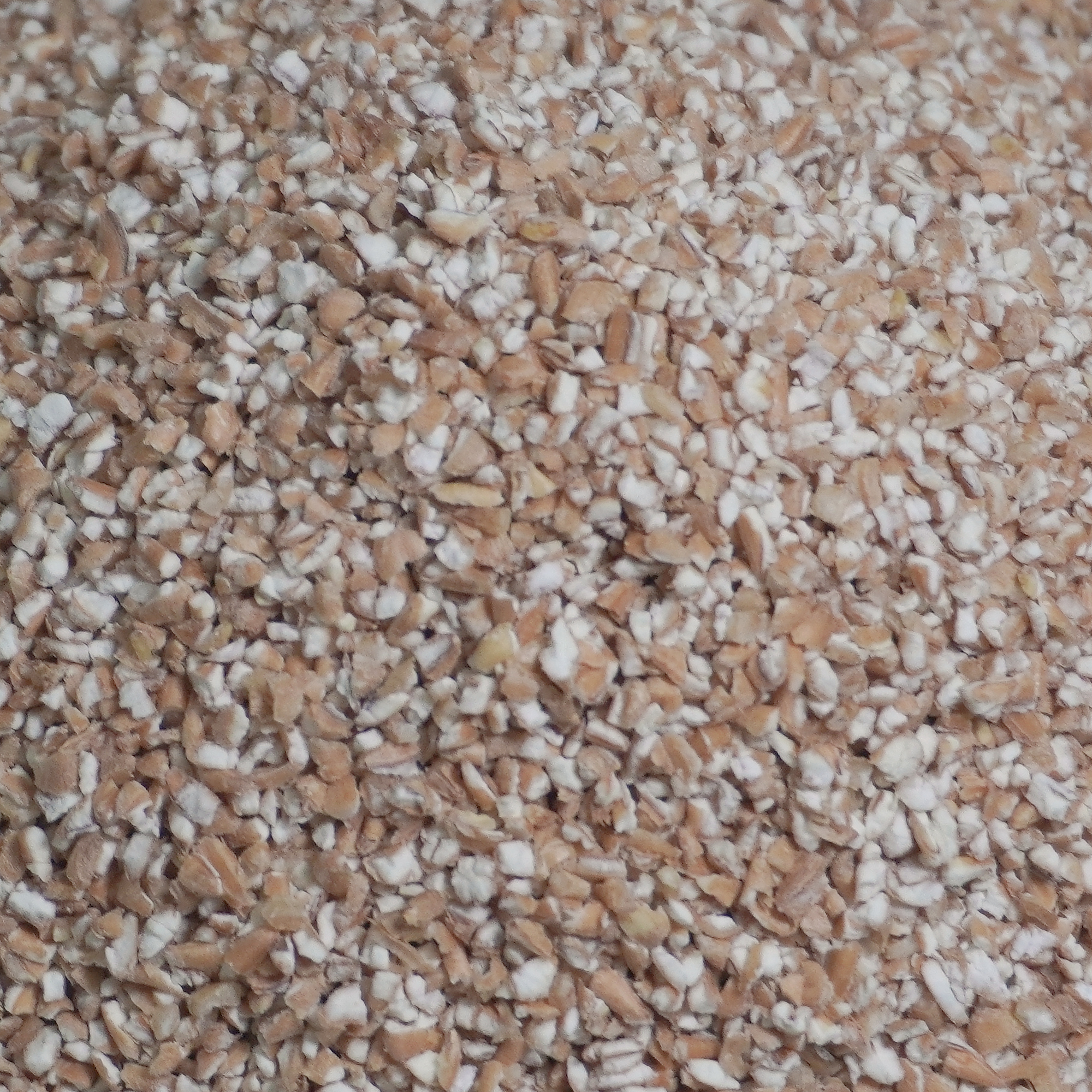
Dalia is simply wheat cracked coarse instead of milled fine. Which grain you start with decides almost everything about how it eats.
Soft wheat, cracked, tends towards mush. The fragments soften unevenly and collapse into the water. Durum does not. Because the endosperm is dense and vitreous, it fractures into hard, angular pieces that keep their edges — and those edges survive cooking. In a namkeen dalia the grains stay separate, the way good pulao does. In milk and jaggery, the outside softens into creaminess while the centre keeps a slight bite. In a moong dal khichdi it gives structure instead of dissolving into the dal.
This is the same property that makes durum the world's pasta wheat. Semolina, vermicelli, macaroni and noodles are all made from it for exactly one reason: it holds its shape in boiling water.
What is in it
Per 100 g of Bundel Dhara Kathiya wheat dalia, verified by an NABL-accredited laboratory:
| Energy | 372 kcal |
|---|---|
| Protein | 9.2 g |
| Dietary fibre | 9.5 g |
| Total fat | 1.4 g |
| Sodium | 26 mg |
By FSSAI thresholds that makes it high in dietary fibre, low in fat and low in sodium, and a source of protein. It is a whole grain, coarsely cracked, with nothing polished away and nothing blended in.
How to cook it
Dry-roast the dalia in a little ghee for two or three minutes until it smells nutty — this is the step most people skip, and it is the one that keeps the grains separate. Then add roughly two and a half parts water to one part dalia and simmer until tender, about fifteen minutes, or three whistles in a pressure cooker. Durum takes slightly longer than soft-wheat dalia and absorbs a little more water; adjust upward rather than downward.
From there it goes three ways, all of them traditional in Bundelkhand kitchens: savoury with cumin, ginger and whatever vegetables the season has given you; sweet, cooked slowly in milk and finished with jaggery; or as a khichdi with yellow moong dal and a soft tadka.
Bundel Dhara Kathiya Wheat Dalia — single-origin, sourced directly from family farms in the Sagar region of Bundelkhand, chakki stone ground in small batches. One ingredient, nothing added. 500 g.
Contains wheat (gluten). FSSAI Reg. No. 21426470000295.
Common questions
Is Kathiya wheat the same as durum wheat?
Yes. Kathiya is the Bundelkhandi name for Triticum durum, the same species grown in Italy, Canada and North Africa for pasta and semolina.
Does Kathiya wheat have a GI tag?
Yes. Bundelkhand Kathiya Gehu was granted a Geographical Indication in March 2024 under certificate number 585 — the first GI awarded to any farm produce from the region. The GI belongs to the registered proprietor; only registered authorised users may label a product as GI-tagged.
Is Kathiya wheat gluten free?
No. It is a wheat and it contains gluten.
Is Kathiya the same as khapli or emmer?
No — a common confusion. Khapli is emmer, Triticum dicoccum, a different species. Kathiya is durum.
Is Kathiya wheat organic?
Not automatically. It is typically grown with low chemical input because the variety needs so little, and many farmers use farmyard manure — but low-input farming and certified organic are different things. Anything sold as organic should carry a Jaivik Bharat or NPOP certification mark. Ours is not certified organic, and we do not describe it that way.
Where can I buy Kathiya wheat dalia?
Very little Kathiya leaves Bundelkhand, and most of what does is sold loose and unlabelled. Ours is available on Amazon, packed in 500 g cartons with the batch and packing date stamped on every unit.
Sources: Geographical Indication Certificate No. 585, granted 30 March 2024 (Application No. 819, Bundelkhand Kathiya Gehu); Geographical Indications Journal No. 185, 29 November 2023; Imperial Gazetteer of India, 1881 and 1908; nutrition figures from NABL-accredited laboratory analysis of our own batch.